Underwater Fishing Camera UK: A Buyer's Guide
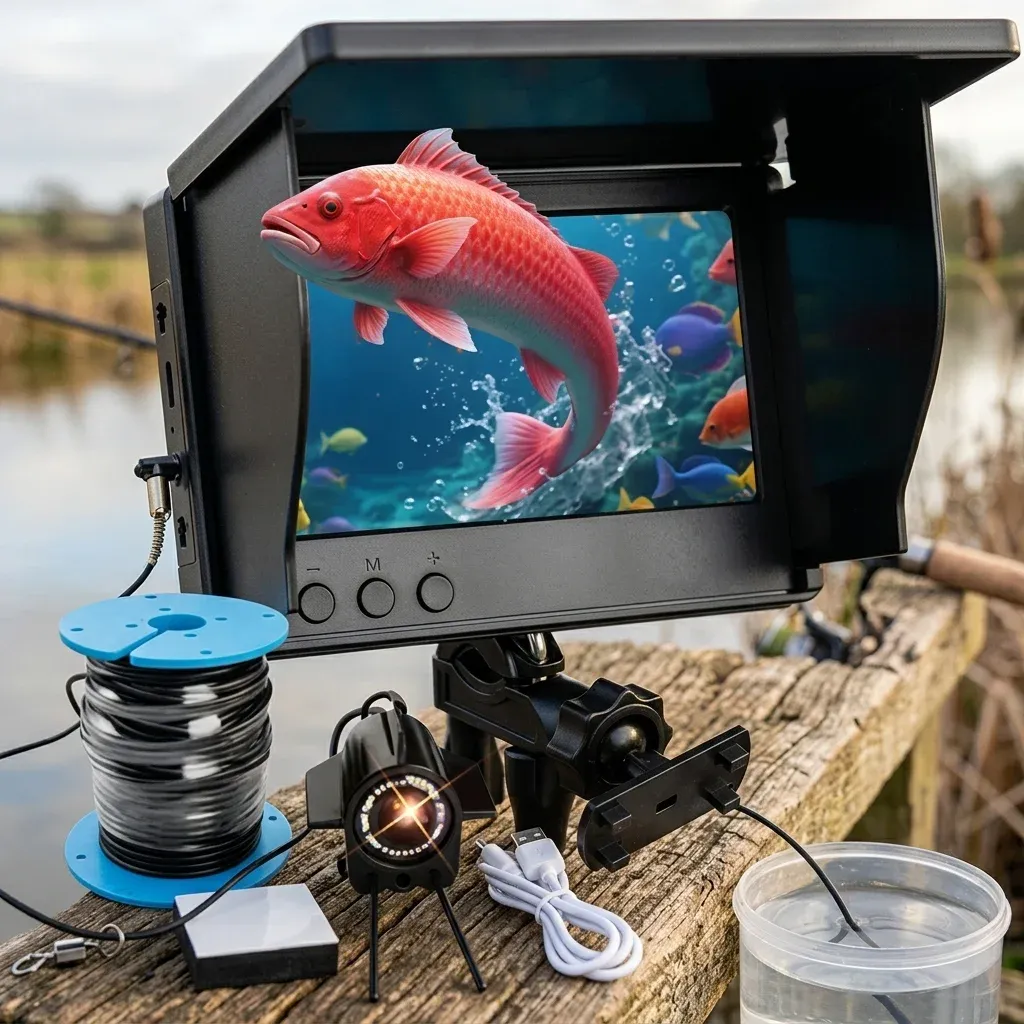
An underwater fishing camera is a small waterproof camera on a cable that sends live video to a screen at the bank, so you can see fish, weed, snags and your own hookbait instead of guessing what is below the surface. For UK anglers the appeal is simple: before you settle into a swim for hours, you can check whether it actually holds fish, what the bottom is made of and how your rig has landed.
TL;DR: On stained British waters the specifications that matter are not megapixels. Prioritise low-light performance with infrared support, a screen you can read on an open bank, a cable long enough for your venues and a battery that copes with cold mornings. As a benchmark for this end of the market, the FishFind portable underwater fishing camera pairs a 4.3 inch TFT LCD screen with 8 infrared LEDs, a 15 m cable and a 2600 mAh battery for £73.16 inc. VAT.
Key takeaways
- An underwater fishing camera gives direct visual confirmation of fish, bottom type and rig presentation, rather than returns you have to interpret.
- UK venues are often coloured and low-light, so infrared lighting, screen readability and cable strength matter more than headline resolution.
- Expect the clearest picture in clear or lightly stained water; in heavy colour, use the camera for close-range checks rather than scanning.
- Always check venue rules first, as some UK fisheries restrict electronic aids.
What is an underwater fishing camera and how does it work?
The kit has three parts: a waterproof camera head, a cable, and a monitor that stays with you on the bank or boat. Lower the camera into the swim and the screen shows a live feed of whatever sits in front of the lens — gravel, silt, weed beds, sunken branches, and fish moving through the picture. Because the feed is genuine video rather than an acoustic return, there is nothing to decode: a bream looks like a bream, and a hookbait buried in silkweed looks exactly like the problem it is.
In low light or coloured water, infrared LEDs around the lens illuminate the scene without throwing harsh white light into the swim. The image under infrared is typically black-and-white, but edges and movement stand out clearly, which is usually what you need to make a decision.
Is an underwater fishing camera worth it in the UK?
If you fish waters where you are effectively casting blind — weedy carp lakes, silty commercials, canals with variable colour — then yes, for most anglers a camera at around the £73.16 mark earns its keep quickly. The honest test is how often you finish a session wondering whether the swim ever held fish at all. If you have sat behind motionless rods asking exactly that, a camera replaces the guesswork with an answer: you either see fish, fresh feeding signs and clean spots, or you see a reason to move.
It also sharpens the feedback loop mid-session. Instead of discovering after four hours that your hookbait settled into soft silt or landed on a mat of low-lying weed, you can check presentation in minutes and adjust the rig, the spot or the feed while it still matters.
Angling in Britain is a serious pastime rather than a niche: the Environment Agency sold 903,216 rod licences in England in 2022/23, generating nearly £21 million that was reinvested in fisheries, according to the GOV.UK Fisheries Annual Report. Tools that help that many anglers make better decisions on the bank are not gimmicks — but they do need to suit British conditions, which is where the buying criteria below come in.
One boundary worth stating early: a camera is for looking closely at a specific spot, not for sweeping large areas of water. If your main goal is mapping depth and contours across a big pit or from a moving boat, a sonar unit serves that job better — see our underwater camera vs fish finder comparison for which to buy first.
What features matter most on UK waters?
Low-light and infrared performance
Most British venues are stained by peat, clay or summer algae, and light fades fast with depth and cloud cover. Infrared lighting is the difference between a usable picture and a dark screen: the FishFind unit carries 8 infrared LEDs for exactly this reason. White LEDs can help in clear coastal water but tend to create backscatter in murky venues, like driving on full beam in fog.
A screen you can actually read outdoors
A monitor that looks fine indoors can wash out on a bright, exposed bank. A practical bank size is around the 4.3 inch TFT LCD used on the FishFind camera: big enough to judge detail, small enough to sit beside a rod without becoming another piece of furniture. Shielding the screen from direct sun with your body or a simple shade improves matters on the brightest days.
Cable length and strength
The cable takes the abuse: gravel bars, mussels, snags and repeated retrieves. Length determines where you can put the lens — 15 m covers margins, near-bank spots and most stillwater swims comfortably, while deep pier and harbour work is where more length starts to matter. Check strain relief where the cable meets the camera, and how easily the camera can be aimed once it is down there.
Battery life in the cold
Cold weather cuts battery performance noticeably, and UK fishing happens in the cold a lot. A 2600 mAh rechargeable lithium battery of the kind fitted to the FishFind unit gives session-length viewing if you use the camera for checks rather than running it continuously. On frosty mornings, keep the monitor insulated between looks — a bivvy pocket or an insulated bag does the job.
Build quality and weather rating
The camera head lives underwater, so sealing matters more than styling: the FishFind camera head is rated IP68 and the unit is specified for -20°C to 60°C, which covers a British winter bank with margin. The monitor end is the part to protect from rain and knocks — it travels in tackle boxes and gets put down on wet ground, so treat it kindly.
How do you use an underwater fishing camera effectively?
Lower the camera slowly to avoid stirring silt, let the picture settle, and work the lens around the spot you intend to fish: confirm the bottom type, look for clean areas in weed, and check for snags before you commit. Then get the camera out of the swim and fish. The anglers who get the most from these tools use them as a decision aid at the start of a session — and again if bites dry up — rather than as a television.
| Quick check | What to look at |
|---|---|
| Camera and cable | Length for your venues, strain relief at the camera end, and how easily you can aim the lens once submerged. |
| Low-light performance | Adjustable or automatic infrared for stained water; expect a black-and-white image under IR. |
| Display | Readable in daylight at arm's length; around 4.3 inches is a practical bank size. |
| Battery | Realistic cold-weather runtime and easy charging between sessions. |
| Venue rules | Confirm the fishery allows cameras before you travel; some restrict electronic aids. |
What can you realistically see in murky water?
Be honest with yourself here, because this is where expectations go wrong. In clear or lightly stained water you can watch fish inspect a bait from a metre or more away. In coloured water, the useful range shrinks to close quarters: bottom type, rig presentation and movement passing the lens. In genuinely thick, silt-laden water, no camera at any price gives a clear long-range picture — infrared improves contrast at short range, and that is the honest limit of the physics.
The practical answer is to match the tool to the job: use the camera for close-range confirmation where it excels, and let watercraft cover the rest.
Who should buy one — and who should skip it?
A camera suits bank anglers on stillwaters, canals and commercials who want confirmation before and during a session; pier and harbour anglers checking structure around pilings; and predator anglers in winter, where infrared earns its keep in dark water. Carp anglers use them to tell a genuinely clean spot from lightly coated silt before committing a baiting plan — the kind of detail a marker lead alone will not settle. If your sessions currently start with a cast and a hope, this is the piece of kit that changes the habit.
Skip it, or at least buy it second, if your real need is covering big water quickly from a boat: that is sonar territory. And if this would be your first piece of viewing kit and the choice feels overwhelming, start with our underwater fishing camera for beginners UK guide, which strips the decision down to three things that matter.
On the buying side, the usual reassurances apply to the FishFind unit: £73.16 inc. VAT with free UK delivery, a 12-month UK warranty, 30-day returns and a 4.8 rating from 252 reviews.
How do you look after a fishing camera?
- Rinse the camera head and cable in fresh water after dirty or brackish sessions, especially harbour and estuary use.
- Dry the cable before coiling it away — water trapped in a stored coil is what ages connectors.
- Protect the lens and connector from grit in transit; a small pouch or wrap is enough.
- Store the battery charged and somewhere frost-free between winter sessions.
Frequently asked questions
Can you actually see fish with an underwater fishing camera in the UK?
Yes, at close range and in reasonable clarity. In clear water you will identify species easily; in stained water you will see shapes, movement and bottom detail near the lens rather than a wide clear scene.
Will lowering a camera spook carp in a pressured swim?
Less than you might fear if you lower it slowly and use infrared rather than white light. Give the swim a few quiet minutes afterwards; most anglers find the disturbance is comparable to a marker float and far less than repeated leading about.
How deep can you use one?
The cable is the practical limit — 15 m on the FishFind unit, which is more than most UK stillwaters and canals ever need. Depth itself is not the constraint; light is, which is why infrared matters more than reach for most anglers.
Are cameras allowed on all fisheries?
No general law restricts them, but individual fisheries and syndicates set their own rules and some restrict electronic aids. Check the venue's rules before you travel rather than at the water's edge.
Does cold weather stop it working?
The unit is specified for -20°C to 60°C, so a British winter is within its rating. Expect shorter battery runtime in the cold and keep the monitor insulated between checks to preserve it.
Ready to try FishFind?
Shop Now — £73.16